
Signage & Vehicle Graphics
Large Format Printing: Your Artwork at XXL Scale
From a single sticker to a fully printed vehicle wrap – printed in our own workshop, not bought in.
Printed in Our Own Workshop
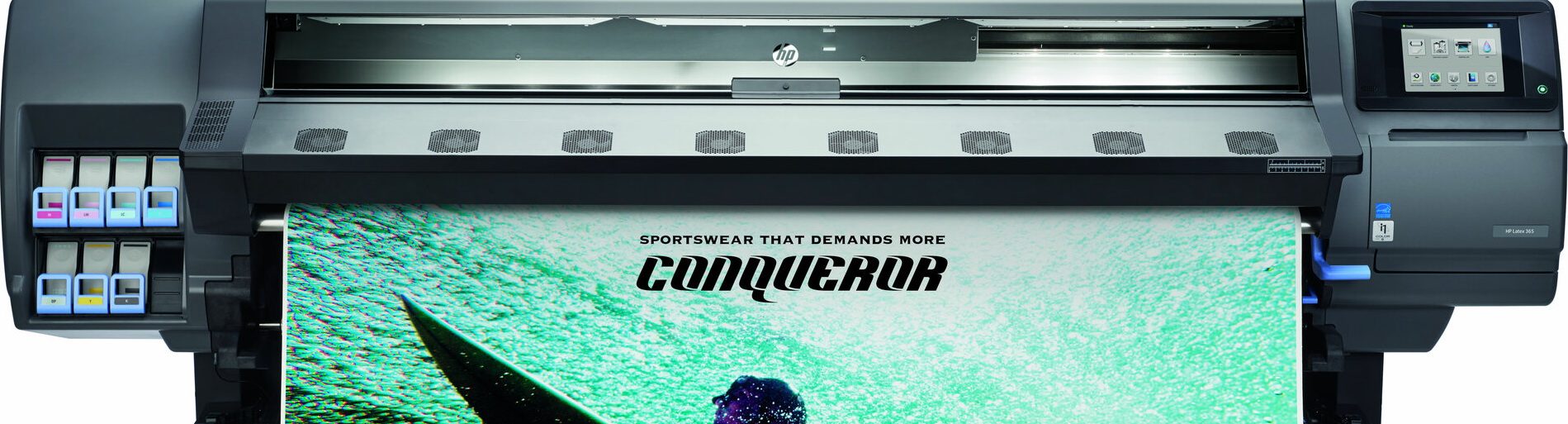
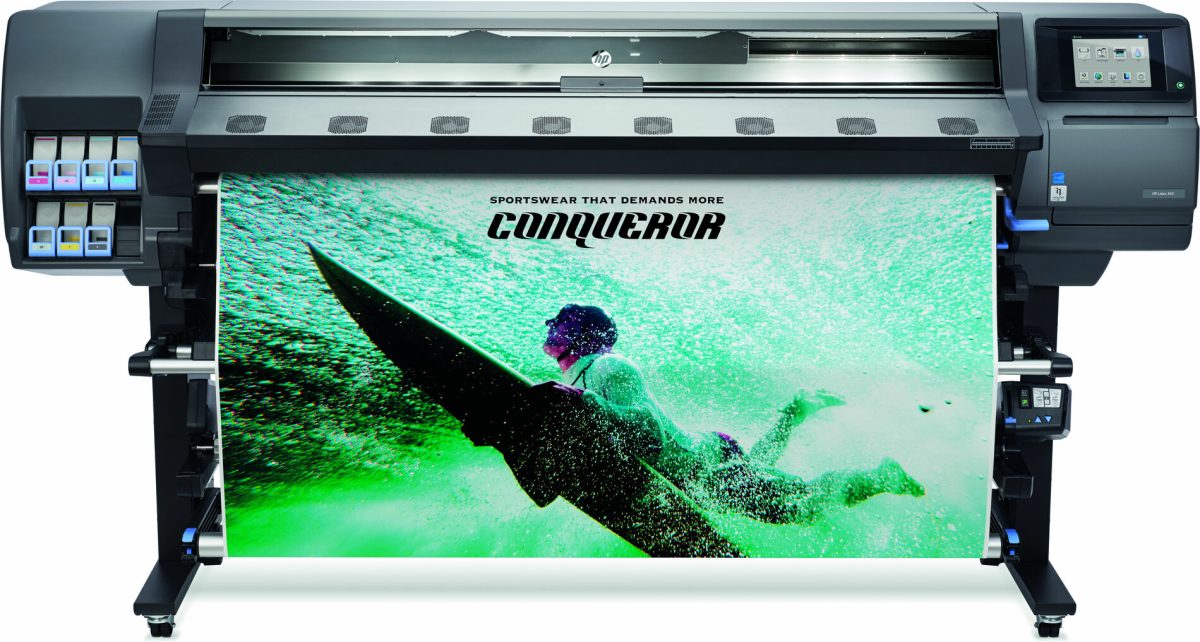
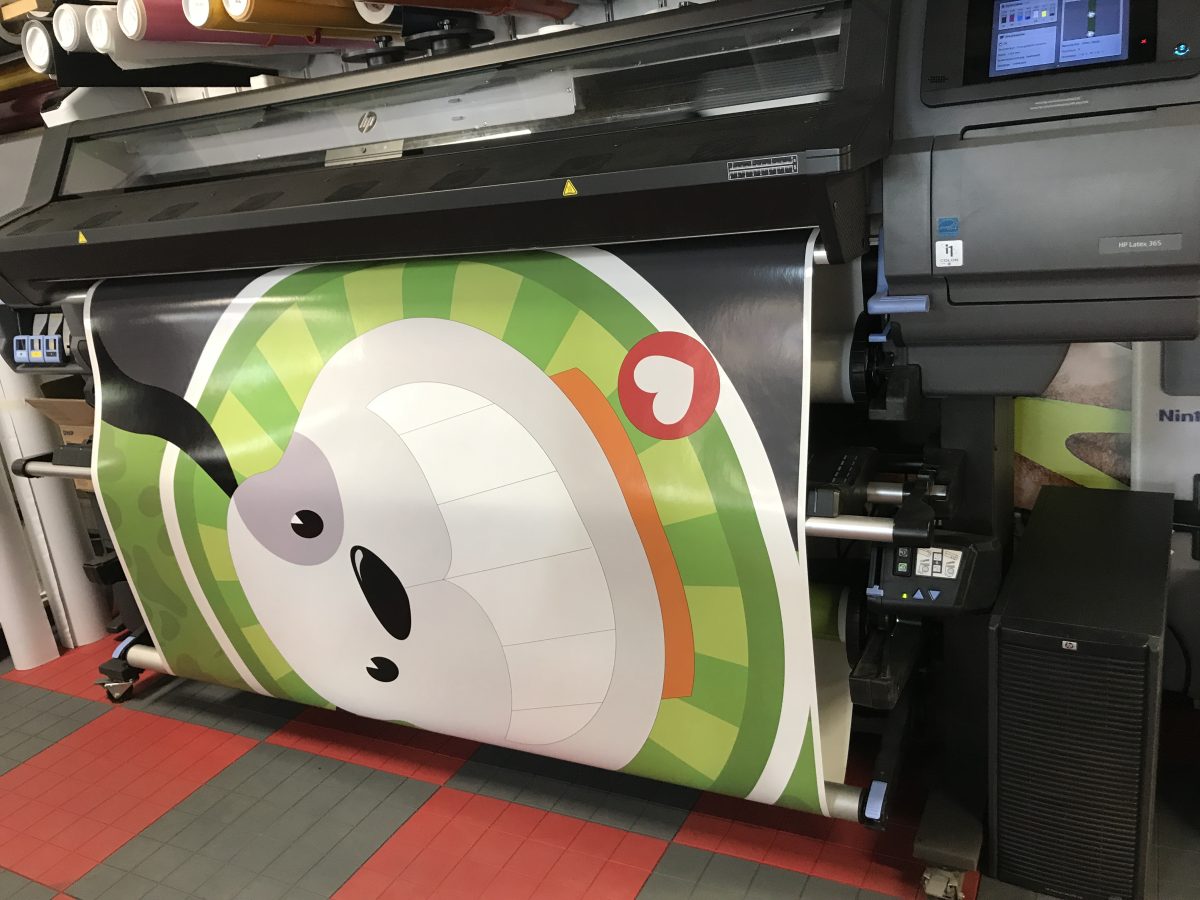
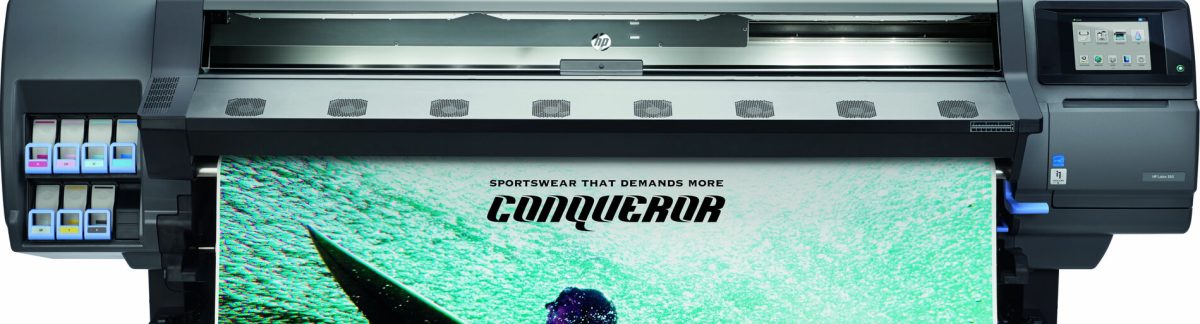
Large format printing, wide format printing, digital printing, XXL printing – they all describe the same thing: printing onto roll material in widths no office printer can handle. We produce it on our own latex presses rather than passing it on.
There is a practical reason for that. Anyone who buys print in is tied to someone else's schedule and, when a colour comes out wrong, can only pass the complaint along. Here the printing happens in the same building as the cutting and the installation – if a panel does not sit right, it is reprinted and refitted without a week going by.
It also means small runs are viable. A single banner, three stickers, one vehicle – digital printing has no minimum order quantity and none of the plate costs of conventional offset printing.
What We Print
Anything that comes off a roll – from self-adhesive vinyl to textile.
Vehicle films
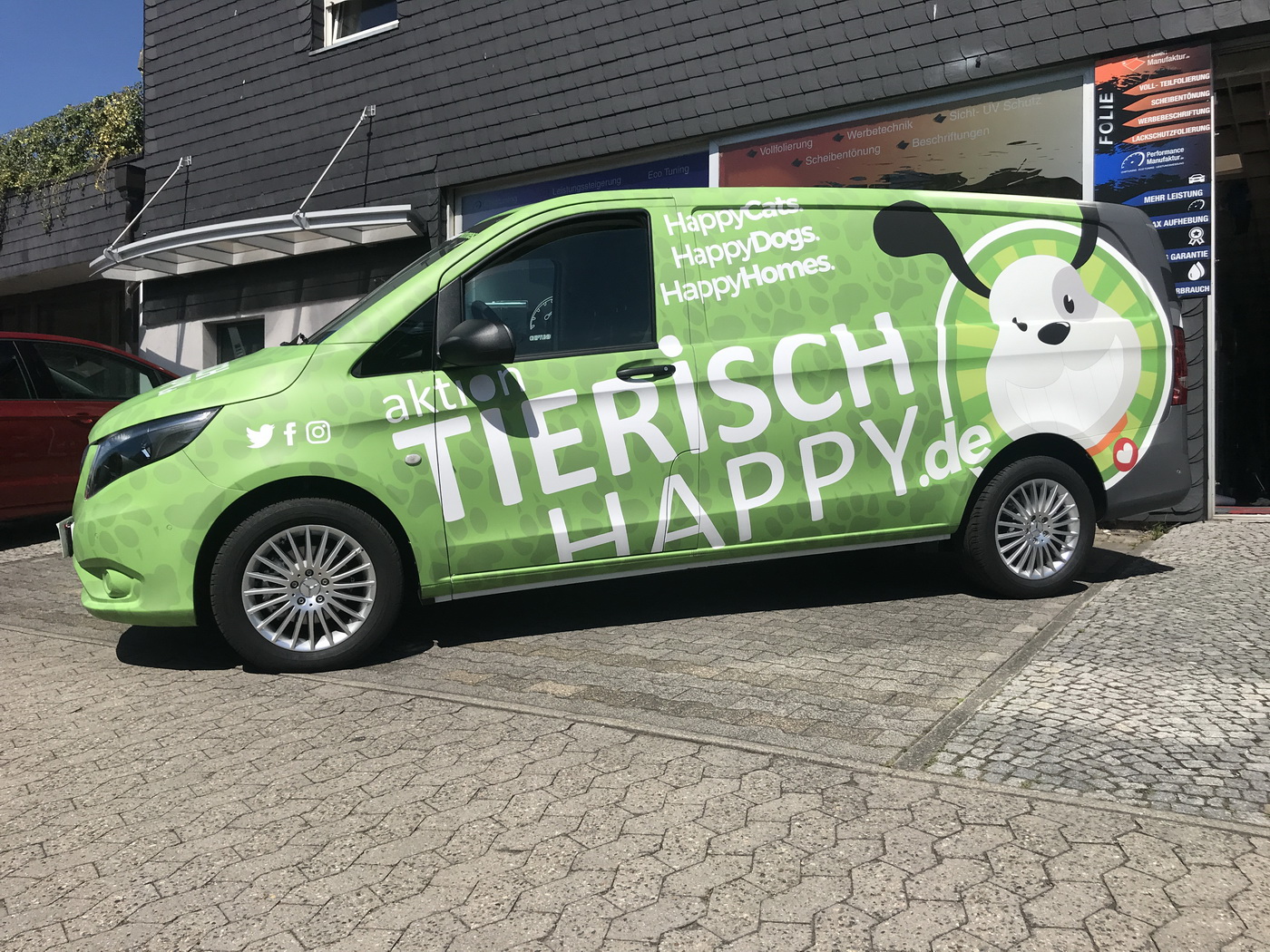
Fully printed film for full wraps and vehicle graphics – photographic motifs, gradients, patterns and complete fleet liveries.
Learn moreBanners, mesh and tarpaulins
PVC banners for façades and fences, mesh banners with an open weave for windy locations, hoarding banners for building sites. Finished with hems and eyelets.
Advertising stickers
From a one-off contour-cut series to sticker rolls: printed, laminated and cut precisely to shape.
Custom wallpaper and wall graphics
Printed wallpaper and large-scale wall motifs made to measure for offices, shops, practices or homes – including around corners and across several walls.
Roll-ups and displays
Trade fair and reception displays including the cassette. The print can be swapped later on its own while the frame stays.
Flags and textiles
Fabric panels, flags and textile banners – soft drape, matt appearance, and they survive transport without creasing.

Why We Print With Latex
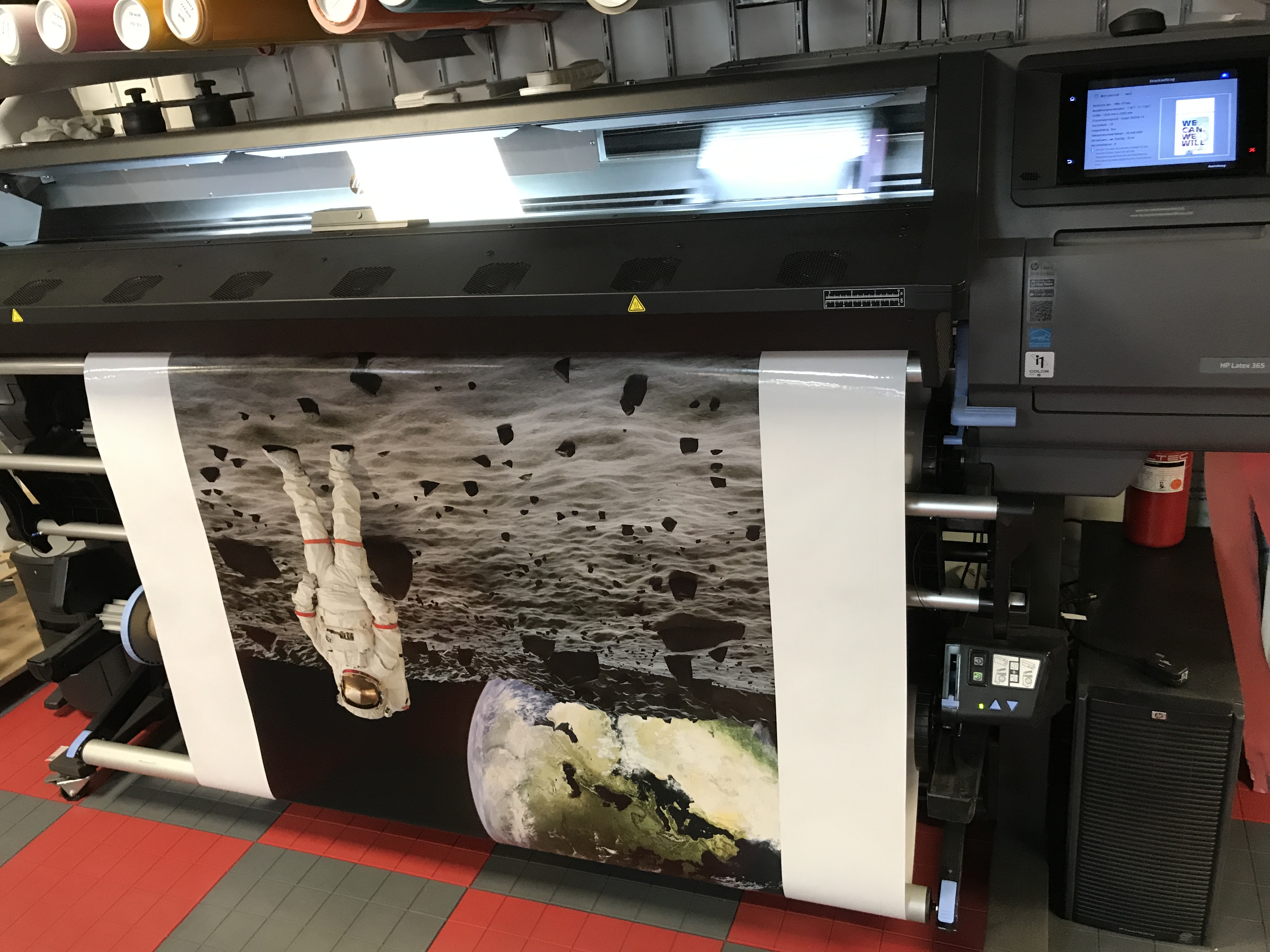
Large format printing essentially offers three processes: solvent, UV and latex. We work with latex printing, for two reasons that affect you directly.
The print is dry immediately. Solvent prints have to outgas before they can be laminated or applied – depending on the material, one to two days. Latex ink dries inside the machine; the panel can be laminated, cut and fitted straight afterwards. On urgent jobs that is exactly what decides the deadline.
The ink is water-based and low-odour. That matters anywhere people spend time and where solvent smell has no business being: medical practices, nurseries, schools, offices, hospitality. A freshly applied shop window smells of nothing.
On top of that comes everyday durability: latex prints are scratch- and wipe-resistant, and with the right lamination they are equipped for years of outdoor use.
Custom Wallpaper: Your Motif, Made to Measure
Precisely because latex ink is low-odour, we also print wallpaper. Call it custom wallpaper, a photo mural, digitally printed wallcovering or simply a wall graphic – it means your own motif, printed to the actual dimensions of your wall instead of coming in off-the-shelf rolls.
There are two routes. Non-woven wallpaper is hung with paste like ordinary wallpaper and can later be pulled off dry – the usual choice for homes and offices. Self-adhesive film needs no paste and sticks to surfaces that will not take wallpaper at all: glass, door leaves, furniture fronts, cupboard walls.
The substrate decides everything. This is where most projects come unstuck: on woodchip or coarsely rendered walls every bit of texture shows through the motif and fine detail disappears. The wall has to be smooth, dry, sound and clean. If it is not, the only answers are preparation beforehand – or a deliberately coarse motif that can live with the texture.
We work from a survey. Wall height and width, sockets, light switches, door reveals and radiator recesses all feed into how the panels are divided, so that no seam runs through a face or a logo. For motifs that turn corners or span several walls we plan the offset in advance.
The most common applications: reception areas carrying a company motif, meeting rooms, waiting rooms, retail spaces, hospitality – and increasingly private homes too, from panoramic photographs to a child's bedroom wall.
Print Files: How to Get a Good Result
The most common cause of a disappointing print is not the printer but the artwork. A few points will save you rework:
Vector data beats pixel images. Please supply logos, wordmarks and flat areas as vectors (PDF, AI, EPS, SVG) – those scale to any size. A logo lifted from a website is usually a few hundred pixels wide and turns to mush on a vehicle door.
Resolution relative to viewing distance. A banner seen from twenty metres needs far less resolution than a wall graphic in an office. Rule of thumb for photographic motifs: send the largest original file you have rather than an upscaled one – we can upscale ourselves, but nobody can bring lost detail back.
Supply your fonts or convert them to outlines, otherwise the machine will quietly substitute something else.
State the scale and add bleed. Set up at 1:1 or 1:10, a few millimetres of bleed all round, and on banners please allow for the hem and eyelets.
And if you have none of that: just send whatever you do have. We will tell you whether it will hold up – and design from scratch if you would rather.
Large Format Printing in the Rhine-Main Area
We print and install from Kiedrich in the Rheingau – for businesses, shops, practices, clubs and event organisers in Wiesbaden, Mainz, Eltville, Rüsselsheim, Frankfurt and Darmstadt. Collection in person is possible, as is shipping.
The print is rarely the whole job. Usually it comes with vehicle graphics or a full wrap, storefront graphics, signage and wayfinding systems, or frosted film with a printed motif. All from one supplier and in one colour scheme.
Frequently Asked Questions About Large Format Printing
What format should I supply my print files in?
Ideally as a PDF with fonts embedded or converted to outlines. Vector formats (PDF, AI, EPS, SVG) are best because they scale to any size without loss. For photographic motifs, please send the largest original file available – JPG, TIFF or PNG. What we cannot work with is a logo copied out of a website or a PowerPoint: that is usually a few hundred pixels and will not even carry a sticker.
If you are unsure, simply send what you have. We will look at it and tell you in advance whether it will hold up.
What resolution do my images need?
That depends on viewing distance, not on a fixed dpi figure. A hall banner seen from twenty metres can be considerably coarser than a wall graphic someone stands in front of in an office. This is why the blanket answer “300 dpi” is usually wrong for large format – 300 dpi across the side of a vehicle would produce a file no software could open.
The useful rule: send the original at the highest quality you have and do not upscale it yourself. We can upscale; nobody can recover detail that is gone.
What is the difference between a PVC banner and mesh?
PVC banner is closed, opaque and stronger in colour – the usual choice for façades, fences and interiors.
Mesh has an open weave that lets wind pass through. That is decisive anywhere a closed surface would act as a sail and tear out its fixings: scaffolding, site hoardings, tall façades, free-standing frames. The price is a slightly grainy appearance close up and a little less colour depth.
If you are unsure, tell us the location and the fixing method and we will recommend the right material.
How long does a print last outdoors?
That is decided less by the print than by the lamination and the location. Unlaminated, a print is mechanically unprotected and fades faster; with suitable lamination, several years outdoors is the normal case. A permanently sunlit south-facing façade demands more than a shaded courtyard.
On vehicles, care matters too: hand washing and a sensible cleaner noticeably extend service life, while harsh car-wash brushes shorten it.
Do I need lamination?
For anything that takes wear: yes. Lamination protects the print against scratches, cleaning agents and UV – on vehicle wraps, floor graphics and outdoor applications it is effectively mandatory. It also determines the finish: gloss, matt or satin.
For short-lived indoor advertising – a promotional sticker, a shop window motif for one season – you can go without and save the cost.
Can you print my own wallpaper – and does it work on woodchip?
Printing it, yes – any time, cut to your wall dimensions. On woodchip, however, the result is disappointing: the texture of the substrate pushes through and swallows fine detail, no matter how good the print is. The same applies to coarsely rendered or uneven walls.
There are two ways out. Either the wall is prepared – old paper off, filled, sanded smooth – or you choose a motif that can live with the texture: large-scale, low in contrast, without fine lines or small type. What does not work is a detailed photograph or a delicate logo on woodchip.
Send us a photo of the wall and we will tell you in advance what to expect.
Non-woven wallpaper or self-adhesive film – which is better?
It depends on the substrate. Non-woven wallpaper is the classic choice for walls in homes and offices: it goes up with paste and can later be pulled off dry without ruining the wall. Self-adhesive film needs no paste and sticks where wallpaper will not hold – on glass, door leaves, furniture fronts or painted surfaces.
For a motif that continues from the wall onto a door or a cupboard, we combine both so that the transition works.
Is there a minimum order quantity?
No. Digital printing needs no printing plates, so a single banner, a single vehicle or a handful of stickers is economically viable. At larger quantities the unit price naturally falls, because setup time and material waste are spread across more pieces.
Does the print smell? Can I put it up in a practice or a nursery?
Yes – that is precisely why we print with latex. The ink is water-based and low-odour, unlike solvent printing, which has to outgas after printing and remains noticeable in a room for a while. A freshly applied shop window or a new wall graphic smells of nothing and the room is usable again immediately.
Can you match a specific corporate colour exactly?
We get very close, but honesty requires one caveat: a digital print mixes the colour from process inks, whereas a spot colour (HKS, Pantone) or a coloured film is a finished pigment. For critical corporate colours we therefore produce a proof print in advance that you can check against your original.
Where a surface has to sit exactly in the corporate colour, a coloured film is often the better route than a print – and it combines with printed elements without any trouble.

reviews
What our customers say
★★★★★ 4,9 von 5 · 68 Bewertungen
Vielen Dank das ihr mich bei der Realisierung dieses Projekts unterstützt habt. Hier hat man es mit einem Hoch professionellen Team zu tun, ich stellte dem Team ein paar Bilder zur Verfügung wie ich mir das Finale Ergebnis grob vorstellte und war von dem geleisteten Beratungsaufwand sehr positiv überrascht. Hier wurden keine mühen gescheut um eine Passende Folie zu finden, nach einem Kurzen besuch vor Ort und letzten Detail Besprechungen wurde das Projekt in Auftrag gegeben. In der Gesamten zeit und bis zu Heutigen tag fühle ich mich äußerst gut beraten und bin mit dem Finalen Ergebnis mehr als zufrieden.
What was done?
Vollfolierung in wasabi Green und Schwarze Folierung des Grills, zusätzlich wurde Lackschutzfolie an allen schwarz glänzenden Elementen, der Motorhaube und dem Grill angebracht.
Super sympathisch, klasse Arbeit, zeitnaher Termin, fairer Preis. Vorbehaltlos zu empfehlen!
Ich habe bereits mein drittes Auto bei Folien-Manufaktur folieren lassen und war immer sehr zufrieden. Auch die Beratung und der allgemeine Kundenservice ist super. Meine Wünsche oder Vorstellungen der Folierung wurden immer erfüllt und zum Teil auch mit Ideen der Folien-Manufaktur übertroffen.